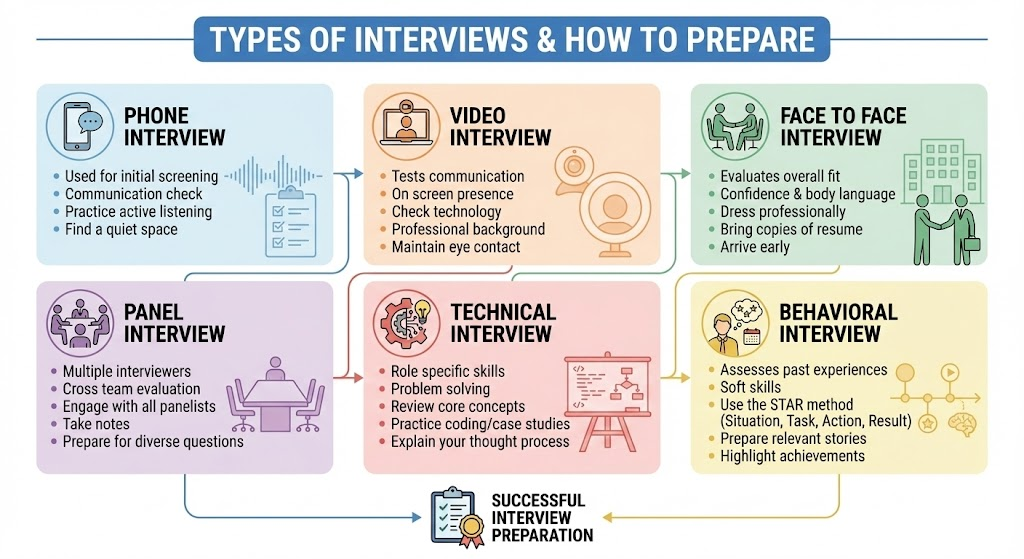
Preparing for an interview is not just about memorizing answers. It is about understanding the format, the expectations, and how employers evaluate candidates in different situations. Interviews come in many forms, and each one tests you in a slightly different way.
Knowing what type of interview you are facing can help you prepare with more confidence and avoid common mistakes.
Common Types of Job Interviews
1. Phone Interviews
Phone interviews are often used as a first screening step. Recruiters use them to confirm your background, communication skills, and basic fit for the role.
How to prepare
- Choose a quiet place with good signal
- Keep your resume and job description nearby
- Speak clearly and at a steady pace
- Smile while talking, as it naturally improves your tone
2. Video Interviews
Video interviews have become very common, especially for remote roles or early interview stages. They combine verbal communication with visual presence.
How to prepare
- Test your camera, microphone, and internet connection in advance
- Dress professionally, even if the interview is remote
- Look at the camera when speaking, not the screen
- Keep your background simple and distraction free
3. Face to Face Interviews
This is the traditional in person interview. Employers assess not only your answers but also your body language, confidence, and interpersonal skills.
How to prepare
- Arrive early to avoid unnecessary stress
- Maintain good posture and eye contact
- Listen carefully before answering
- Be polite to everyone you meet, not just the interviewer
4. Panel Interviews
Panel interviews involve multiple interviewers at the same time. They are common for managerial roles or positions that work across teams.
How to prepare
- Address your answers to the person who asked, but include the rest of the panel with eye contact
- Stay calm and take a moment before responding
- Expect follow up questions from different perspectives
5. Technical Interviews
Technical interviews focus on role specific skills such as coding, system design, accounting, or engineering knowledge.
How to prepare
- Review core concepts related to the job
- Practice explaining your thought process out loud
- If you do not know an answer, explain how you would approach the problem
6. Behavioral Interviews
Behavioral interviews aim to understand how you handled situations in the past. Questions often start with phrases like “Tell me about a time when…”
How to prepare
- Use the STAR method: Situation, Task, Action, Result
- Prepare examples related to teamwork, conflict, leadership, and problem solving
- Be honest and focus on what you learned from the experience
Common Interview Tips That Apply to All Formats
- Research the company, its products, and its culture
- Read the job description carefully and match your experience to the role
- Prepare a short introduction about yourself
- Practice answering common interview questions, but avoid sounding rehearsed
- Ask thoughtful questions at the end of the interview
- Follow up with a short thank you message after the interview
Final Thoughts
Interviews are not meant to trick you. They are a two way conversation to see if both sides are a good fit. By understanding the type of interview you are facing and preparing accordingly, you can approach the process with clarity and confidence.
Good preparation does not guarantee an offer, but it greatly increases your chances of making a strong impression.